PERÚ
The Model That Is Impoverishing Amazonian Turtle Guardians
by Bianca Padró Ocasio, Aramís Castro y Gianfranco Huamán
con la colaboración de Jorge Carrillo
More than a million taricaya river turtles are raised every year in the Peruvian Amazon under a state-run program that once promised sustainable income for local communities. Highways of Predation, an investigation by five independent media outlets, found that the project not only fuels a declining market but is also linked to illegal wildlife trafficking.
It’s nearly midday, and Samuel*, a 55-year-old Kukama man, should already be out collecting turtles in the Pacaya Samiria Reserve, one of the largest and most biodiverse protected areas in the Peruvian Amazon.
His morning has slipped away as he searched for fuel, food supplies, and a way to repair the only engine of the small boat his livelihood depends on.
“I have to go in today no matter what,” Samuel says anxiously. “We’ll bring in our food, rest for a bit, then head back to the nesting site so we have containers ready to collect again the next day.”
This is the most important season of the year for workers like Samuel, who care for and collect Podocnemis unifilishatchlings—known locally as taricayas—along the Marañón River in the Pacaya Samiria Reserve. Recognizable by the yellow spots on their heads, these turtles are agile swimmers and voracious foragers, feeding on fruits, aquatic plants, insects, and small fish. They spend most of their lives in the water, emerging only to lay their eggs as the river naturally recedes. They are also a key source of sustenance for the communities living inside the reserve.
From June to October, Samuel and his colleagues transport taricaya eggs to artificial beaches, guarding them until they hatch. As compensation for their work, they’re allowed to sell between 40% and 60% of the hatchlings. Locally, people buy the eggs or wild meat for their nutritional value; internationally, hatchlings are exported in large quantities as pets or food, mostly to Asian markets.
Workers like Samuel also help repopulate the more threatened charapa turtle (Podocnemis expansa), which is critically endangered—unlike the taricaya, which is currently listed as vulnerable.
For the past three decades, Peru has showcased the management of the taricaya as a conservation model—one that can support Amazonian communities and curb wildlife trafficking. In many cases, former poachers themselves were trained to form management groups, ensuring the species’ long-term availability.
But behind this success story, the communities tending the nests face unpredictable payments, rock-bottom prices, and other economic pressures in a market that seems increasingly saturated.
“It’s good-hearted work, but at what cost? At the cost of poor people’s sacrifice,” says Segundo Lomas, a resident of San Martín de Tipishca, a village inside the reserve. “They only track the expenses, never the daily labor.”
Meanwhile, taricayas continue to be targeted by traffickers. Some privately owned hatcheries licensed to export them have inconsistencies that may enable the laundering of illegally sourced wildlife. The most emblematic case is the Depredadores del oeste [Predators of the East], a criminal organization in Peru that used a hatchery and falsified documents to launder illegally sourced animals.
Waiting for Income in a Saturated Market
Peru is the only Amazonian country that allows the commercial trade of live wildlife, under the premise that use will be sustainable. Sales fall under two state-regulated categories: community-based management groups like Samuel’s, and private hatcheries that breed, raise, and export animals.
Samuel lives in the Indigenous community of Leoncio Prado, a Kukama village of 495 people along the Marañón River in the district of Parinari, Loreto. Their territory borders the northern edge of Pacaya Samiria, Peru’s largest sustainable-use natural reserve at 2.08 million hectares—roughly the size of El Salvador.
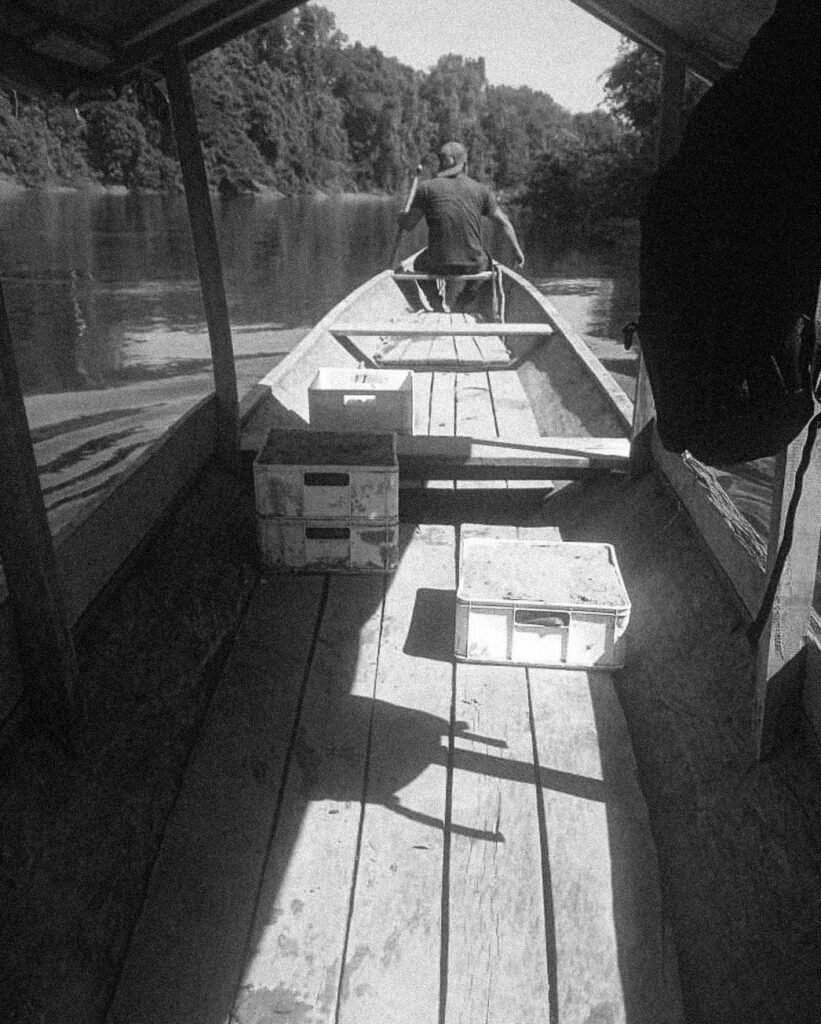

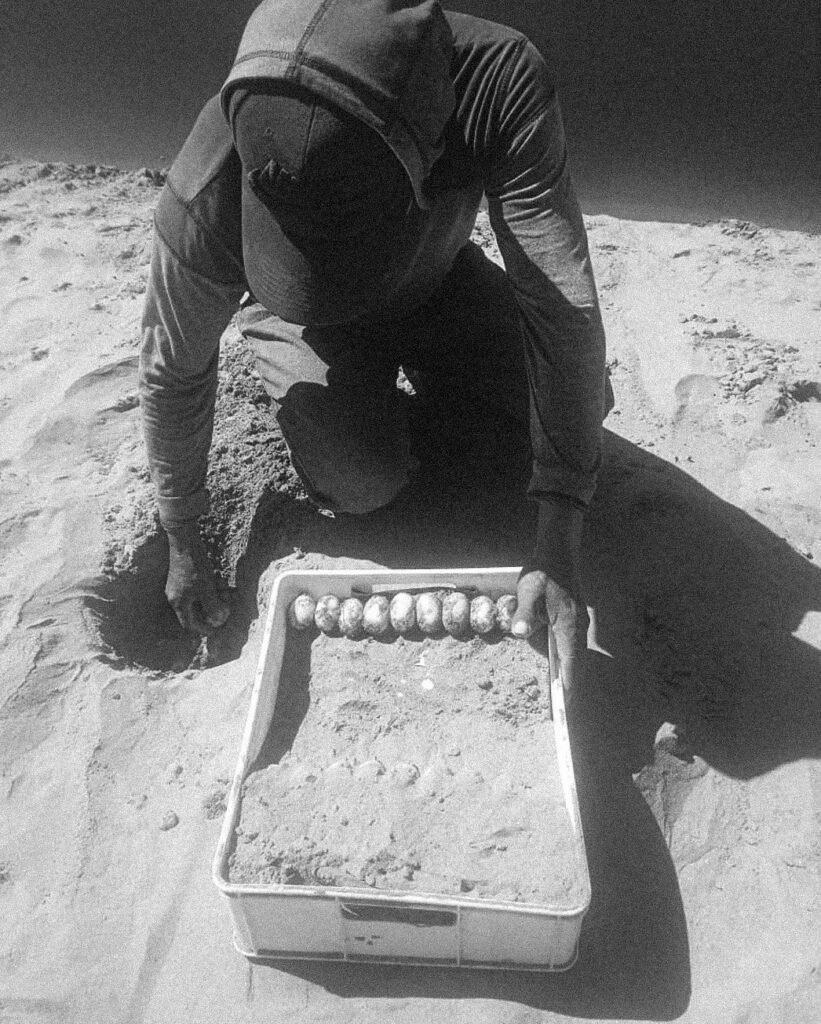
In 2024 alone, 582,315 taricaya hatchlings were released into the wild, and 539,559 were commercially traded. The National Service of Protected Areas (Sernanp) oversees conservation, while the National Forest and Wildlife Service (Serfor) authorizes sales and exports.
Taricayas nest twice a year; charapas only once. Both species share the same habitat. Charapas—considered the largest freshwater turtles in the Amazon—cannot be mass-marketed because they remain critically endangered. Their recovery is also challenging roughly 30% of the eggs collected by workers like Samuel do not survive transport to artificial nesting beaches, according to Sernanp. Workers are allowed to sell non-viable charapa eggs as compensation, in an effort to curb illegal sales of charapa eggs in Amazonian cities. In 2024, 334,518 charapa hatchlings were released in Pacaya Samiria.
Partly thanks to the resilience of taricaya eggs compared to charapa eggs, the program has been replicated successfully in multiple regions. But several members of management groups told OjoPúblico that the model has left extractors at the mercy of an international market that is increasingly unequal and oversupplied.
Members earn an average of 3 soles (USD 0.89) per taricaya; after expenses, their profit drops to 2 soles. This income is split among groups of eight to twelve people or more. Each group is authorized to sell a fixed number of hatchlings in designated areas. Samuel’s group sells 45,000 turtles per season. Members earn around 12,000 soles per year (approx. USD 3,450), below Peru’s annual minimum wage of nearly USD 3,800. Meanwhile, several taricayasales websites reviewed by OjoPúblico show that on the global market a single taricaya can sell for more than USD 245.
More troubling, several management-group members say they have not been paid for last year’s sales. Their buyers have informed them they will no longer purchase hatchlings due to a “saturated market.”
The export of taricayas through private hatcheries also inspires little confidence, according to experts consulted by OjoPúblico. Over 100 km from Samuel’s community, along the Iquitos–Nauta Road, many licensed hatcheries operate. In theory, breeding turtles in controlled environments should generate income without affecting wild populations.
But OjoPúblico reviewed seven hatchery projects submitted to the Loreto regional government since 2020 and found serious deficiencies. Some plans omit the initial number of animals to be kept; others claim snakes could be stored in plastic containers.
Saving the Taricaya
For a species that was once scarce in the 1980s and 1990s, these turtles, which measure about 44 cm in length, have made a notable comeback and remain a crucial food source for local populations.
In addition to local egg consumption, natural predators of taricaya hatchlings include the black tegu (Tupinambis teguixin) and birds such as the shihuango (Milvago chimachima) and various vultures.
Each taricaya lays an average of 35–45 eggs per nest. Using their hind legs, they dig holes in the sand during the low-water season. This year, some workers say nesting began late due to unusually heavy rains.
Many management groups have depended on this work as their sole source of income for decades. Communities still recall the arrival of Finnish biologist Pekka Soini Nordberg in the early 1990s, who trained residents. Conservation efforts for taricayas and charapas date back to the 1970s.
Perceptions—both local and official—hold that taricaya recovery has been remarkable, but studies remain limited; population censuses are difficult and often rely on estimates.
A count carried out between 2018 and 2020 suggests the species’ conservation status ranges from fair to good, varying by region depending on exploitation levels. Officially, Podocnemis unifilis is listed as vulnerable in Peru’s Red Book of Threatened Wildlife (2018) and appears in Appendix II of Convención sobre el Comercio Internacional de Especies Amenazadas de Fauna y Flora Silvestres (CITES). Exporting countries must therefore ensure, through studies, that trade will not endanger the species.
Rosario del Águila Chávez, a biologist at the Institute of the Common Good, arrived in Pacaya Samiria in 1996 and worked there for 15 years. She helped lead the community implementation of the taricaya conservation program launched in 1994 in the Yanayacu-Pucate sector. One key achievement, she says, was formalizing the activities of former poachers during a boom in taricaya egg and hatchling extraction.
“People have even set up community-run initiatives selling eggs in supermarkets with labels to market them as a formal product,” she explains.
Today, according to reserve director Edson Del Águila Alván (Sernanp), forty management groups are active in the reserve, representing 365 families. Each plan remains valid for five years.
In the early days, selling taricaya hatchlings—also known as charitos—generated strong demand and clear incentives for buyers who saw the species as a global market opportunity.
“The demand was so high that groups could name their price—fair prices,” Rosario recalls. “Buyers even traveled to the area to pick up the turtles.” At that time, hatchlings sold for up to 10 soles (USD 2.96).
But today, the success of conservation has created economic dependence on a resource whose exports have sharply declined.
According to official data analyzed by OjoPúblico, taricaya exports peaked in 2019 at nearly USD 2.1 million (FOB value). By 2024, the figure had fallen to just over USD 530,000; in 2025, exports have yet to reach USD 400,000. Main destinations remain Hong Kong, China, and Taiwan. Since 2019, Peru has exported more than 2.5 million taricayas.
Samuel’s group sells to MF Tropical Fish EIRL, owned by businesswoman Milagros Ferreyra, one of the main taricaya buyers in the Peruvian Amazon. Samuel says the company owes his group payment for last year’s hatchlings—around 7,000 soles (USD 2,070). The company’s explanation, he says, is difficulty exporting the product. Without payments guarantees, the debt could reach 14,000 soles (USD 4,140) if this year’s turtles also fail to sell.
“We’re just waiting for the payment to cover the debt,” Samuel says. Their fuel and supply provider has already refused to continue offering credit.
OjoPúblico contacted Milagros Ferreyra Ahuanari, but she did not respond.
The labor required to save taricayas—and to earn from them—is intense. As soon as turtles nest on natural beaches, workers carefully transport the delicate eggs in sand-filled buckets. But sometimes they arrive too late, finding that illegal collectors have already cleared the nests.
Management groups transplant the eggs to artificial beaches near Sernanp checkpoints, where they “replant” them. Their work doesn’t end there. They must record every stage of the nesting process—egg counts and hatchling counts—which Sernanp later verifies.
“We work all day long, from nine in the morning until ten at night,” Samuel explains. At day’s end, they rest at the control posts, only to continue the next day before returning home.
According to Sernanp, egg and hatchling counts are carried out “manually and directly” by reserve staff. Records are checked again when groups request the Certificate of Origin required for commercial sale. In exceptional cases, recounts may be conducted to ensure an “accurate and traceable official record” of every stage of use.
Findings of Fauna at the National Level (2000–2024)
* Source: Superintendencia Nacional de Aduanas y de Administración Tributaria (SUNAT)
| Category | Count | % |
|---|
The Hatcheries
Raising taricayas in private hatcheries is very different from community-based management. Under current wildlife law, there are only minimal requirements for submitting a hatchery management project. Applicants must present a management plan to the regional wildlife office; officials then review or approve it, and the process is supervised by a regent chosen by the applicant.
Providing detailed scientific backing is optional: regulations do not require it. Nor is there a required time frame—plans can propose three, five, or more years of operation.
Hatcheries are also not required to specify where their founding stock will come from. In the files reviewed by OjoPúblico, unlike in community groups, applicants merely state that animals could be acquired from other hatcheries, rescue centers, or “from the natural environment.” No locations are specified.
Biologist Nancy Carlos Erazo of the Universidad Científica del Sur stresses that scientific supporting data is “vital,” as it determines how animals should be cared for. She also notes that key details—such as age and sex—should never be omitted.
“Capturing a female at a given life stage is not the same as capturing one at another. It depends on the species’ biology, and that requires scientific justification,” she explains.
Inconsistencies in Management Plans
The review also found plans submitted by Milagros and her sister Lita Ferreyra Ahuanari, businesswomen whose companies accounted for 53.3% of Peru’s total wildlife exports between 2014 and 2023. Their firms, based in Loreto, exported turtles, chameleons, iguanas, and lizards to Hong Kong, China, Taiwan, and other countries.
Lita Ferreyra Ahuanari, representing Ferreyra Fishes & Turtles EIRL, received approval in May 2023 to expand her hatchery Fundo Gaviota. The company declared a 19,000-square-meter facility with an expected annual production of 40,000 taricayas.
Yet the plan includes no scientific or technical justification for that estimate. It also fails to specify which “authorized breeding centers” would supply the founding stock, nor does it reference the Ferreyra sisters’ longstanding role in the wildlife trade.
Milagros Ferreyra Ahuanari—currently under investigation by tax authorities for suspected money laundering—received authorization in July 2025 to expand the hatchery of her company Reptilians Turtles and Tropical Fish EIRL, approved to manage Crocodilurus amazonicus, a semi-aquatic lizard listed under CITES and found across South America.
In its plan, Reptilians Turtles and Tropical Fish states that it will begin with an initial population of 60 females and 20 males, each valued at USD 50. It also claims—without providing further detail—that there will be 300 hatchlings each year. The approved document does not specify where the initial breeding stock will come from; it merely notes that they will “come from authorizations granted by the sector.”
The limited information in the proposal was also flagged in an advisory report prepared by the Ministry of the Environment, Peru’s CITES scientific authority. “The request does not specify the areas for the potential collection from the wild,” the report states, adding that it was not possible to analyze “population management projections” because there was no available information about the species or its “ex situ management,” meaning its husbandry in captivity.
Earlier attempts by OjoPúblico to contact the Ferreyra Ahuanari sisters were likewise unsuccessful.
An OjoPúblico analysis of enforcement actions by Serfor since 2009 found that the taricaya is the third most trafficked live species in Peru, with a total of 7,575 turtles seized in that period—behind only bees (Apis mellifera), the yellow-winged parakeet (Brotogeris versicolurus), and frogs of the Telmatobius genus, which includes the Titicaca water frog. This total does not include eggs or turtle parts.
Uneven protections and lingering uncertainties
Despite the success of the taricaya repopulation program, some experts consulted by OjoPúblico have raised concerns about large-scale restocking and the release of these turtles into areas where they are not endemic or where they may disrupt the reproduction of other species. There is little evidence to determine, for instance, whether these releases may be saturating the habitat of the larger charapa turtle.
According to Edson Del Águila Alván, the Peruvian Amazon Research Institute (IIAP) is currently studying the genetic variability of the taricaya to assess the long-term effects of the program after decades of repopulation efforts.
Enrique Michaud, who headed Serfor’s Directorate of Sustainable Wildlife Management until May 2024, told OjoPúblico that the taricaya export permits issued during his tenure involved such large quantities that it was difficult to understand how much income they generated for the Indigenous communities collecting them.
“Honestly, I felt bad signing those CITES permits—each permit was for 20,000 or 30,000 turtles […] And for each of those turtles, the community received twenty cents. It was absurd. I would think, ‘How can you possibly pay so little for such a valuable resource?’” he said.
Rider Yuyarima Aquituari, along with his management group Los Manatís in the community of San Martín de Tipishca, collected around 24,000 taricayas in 2024. However, he says that the company they work with has already informed them that it will not be buying taricayas next season.
When the company pays them, the amount is enough to cover that year’s costs, but nothing is left for food or fuel for the next season, Rider explains. To make ends meet, the other 12 members of the group hunt paca (Cuniculus paca), white-lipped peccary (Tayassu pecari), and fish.
“They pay us, we divide it, and then everyone takes responsibility for themselves. But there’s nothing left to start the new year,” Rider says. “It doesn’t add up. The total looks big when the company deposits money to the organization… but it doesn’t work because there are so many of us.”
Sernanp told OjoPúblico that it is aware of these concerns in the taricaya market. Officials pointed to several commercial initiatives, such as creating local companies formed by management groups like Pacaya S.A. and ECOMATSA, to promote the direct sale of taricayas and their by-products. They also said they are exploring alternative natural resources that could help broaden economic activities.
Samuel says that several community members who once harvested taricayas have migrated to Amazonian cities like Nauta or Iquitos because they can no longer support themselves. He worries because their role also includes monitoring and protecting taricaya nests.
“Sometimes we don’t go in for two or three days, and people [illegal hunters] are already there… I don’t know how, but they must know when we’re gone,” Samuel says. According to Del Águila Alván, “there is always the possibility that some members decide to stop participating, as happens in any community-based process.”
For his part, Michaud, the former Serfor official, says that another concern in the trade, both for management groups and for hatcheries, is the condition of the turtles once they are taken for export. “We had no idea what was happening—or what is happening—with those turtles once they get here [to Lima],” he says. “There are things that are non-negotiable, and our animals, our wildlife, all the value of our megadiversity—that is something we cannot bargain away.”
Michaud explains that the taricaya trade resembles the way alpaca or vicuña fiber markets function. In any bio-business linked to megadiversity, “very few people make a lot of money at the expense of many others.” He adds that “the State needs to play a more decisive role” in managing the resource.
Segundo Lomas, a community member from San Martín de Tipishca, is encouraging others to pursue different bio-businesses, such as working with punga colorada (Pseudobombax munguba). The seed of this Amazonian plant, Segundo explains, is dried in the sun and produces a fiber that can be used in value-added textiles.
This year, together with the nonprofit Amanatari, 20 people from his community carried out their first collection of the fruit for commercial use. He estimates that 50 fruits produce one kilo of fiber, and they were able to gather 140 kilos in this first season. Segundo says they earn 90 soles per kilo, and that most of the group’s members are women.
“I’m proud that we are part of the reserve and proud to contribute to its protection,” he says, “but it has to be compatible with the work we do.”
From inside his home, Samuel watches through the window as his neighbors help him repair the boat’s motor.
On one hand, he recognizes the importance of seeking new income opportunities. They are working with the Ministry of Production to sustainably use, for example, paiche (Arapaima gigas)—an enormous Amazonian fish that is critically endangered—in the reserve’s lakes. Through their collaboration with the State, they have recorded 988 adults and 488 juveniles in a single lake. Samuel says that if their management plan is approved, they will be allowed to harvest only 10%.
But on the other hand, he knows he will continue working with his taricaya management group one way or another. After 15 years of returning to the same beaches to recover eggs during the dry season, he says the turtles almost seem to recognize them.
“At this time of day, they’re still laying [eggs],” he says. It wasn’t like this before. “It used to be three or four in the morning, when there was no one on the beaches. Now people don’t bother them anymore. That’s why they’re laying calmly until the time the workers leave the beach.”
*Samuel is a pseudonym used to protect the individual’s identity due to fear of reprisals.